Legalization, Notarization & Apostille of BVI company documents
Overview
Authenticating BVI corporate documents for international use involves two sequential processes — notarisation by a BVI-enrolled notary public and, where required, apostille by the sole competent authority designated under the Hague Apostille Convention. Understanding which documents require notarisation before they can be apostilled, who is authorised to perform each function, and how the BVI online certificate verification portal can substitute for a physical certified copy in due-diligence contexts is essential for any cross-border transaction involving BVI companies.
Here's the full legal and practical framework: the governing statute (the Commissioners for Oaths and Notaries Public Act 2007), the 127 enrolled notaries public, the specialist service providers, the two-track document authentication matrix and the Hague apostille process as centralised in the Office of the Deputy Governor since March 2025
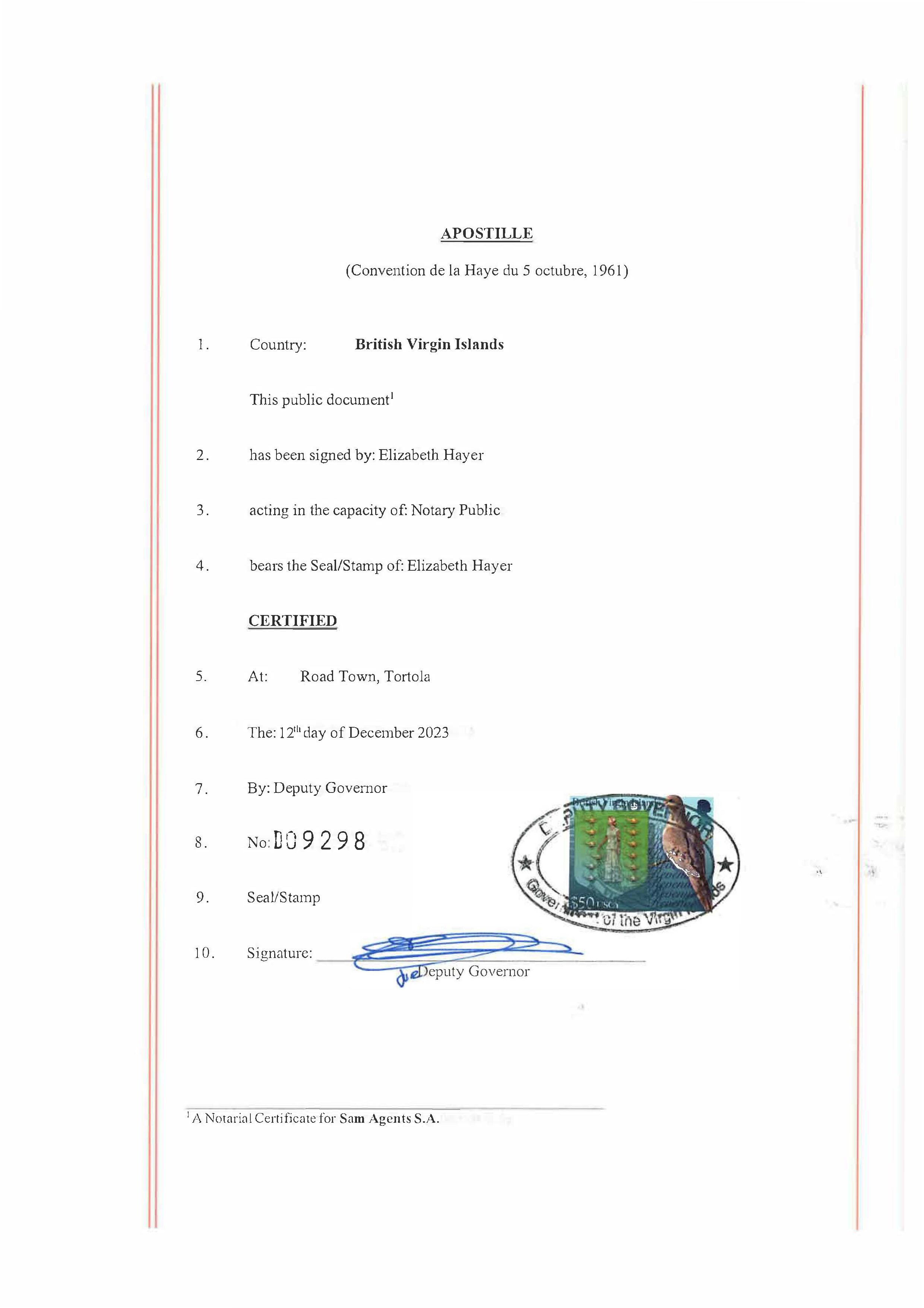
Here's a sample of the first page of a BVI Apostille document
A sample of a Notarial Certificate
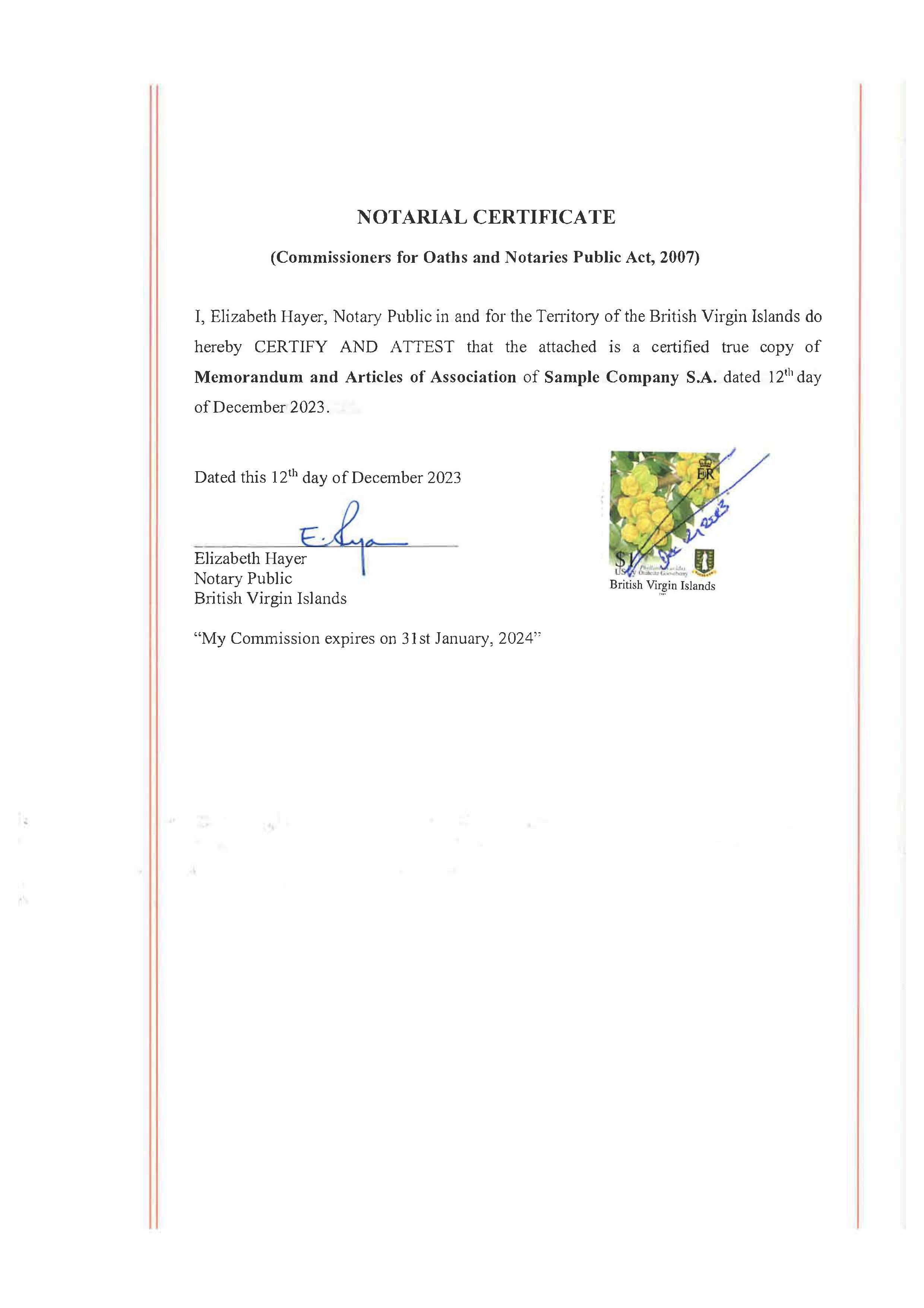
Here's how a Memorandum & Articles of Association of a BVI company looks when notarized
Legal Framework
Notaries public in the British Virgin Islands are governed by the Commissioners for Oaths and Notaries Public Act, No. 7 of 2007 (sometimes cited as CAP.12). The Act establishes two distinct categories of legal practitioners authorised to authenticate documents: Notaries Public — who hold broader powers for documents intended for international use — and Commissioners for Oaths, whose function is primarily the administration of oaths and taking of affidavits for domestic proceedings. In practice, virtually all enrolled BVI notaries are also commissioners for oaths; the reverse is not always true.
Section 28 of the 2007 Act requires the publication of an annual list of all enrolled notaries public and commissioners for oaths. The 2025 list, published by the BVI Government, shows 127 Notaries Public currently enrolled. The list is published at bvi.gov.vg and entries include name and address only; individual telephone numbers and email addresses are not included in the official publication.
Appointment is administered by the Supreme Court of the Virgin Islands, which forms part of the Eastern Caribbean Supreme Court (ECSC) structure. Enrolment as a BVI notary public requires admission as a barrister or solicitor of the ECSC (BVI); every notary on the 2025 list is a practising lawyer. There is no separate professional body dedicated exclusively to notaries; the BVI Bar Association (BVIBA) — reachable at info@bvibar.org — is the de facto professional association for all BVI legal practitioners, including notaries.
Since 13 August 2021, notaries public carrying out certain transactional services (such as company formation and client account management) are required to register with the Financial Intelligence Agency (FIA BVI) under the Anti-Money Laundering and Terrorist Financing (Amendment) Act 2021 (see fiabvi.vg).
The 127 enrolled notaries are spread across law firms and chambers throughout Tortola and, to a lesser extent, Virgin Gorda
Registry of Corporate Affairs Documents: Which Require Notarisation?
p>The BVI Business Companies Act, 2004 does not impose a general notarisation requirement for domestic filings by a BC. Whether a BVI corporate document requires notarisation before it can be used — particularly in foreign jurisdictions — depends on its source: documents already bearing the original signature of an authorised BVI government official (i.e., the Registrar of Corporate Affairs) carry the character of a public document and may proceed directly to apostille without prior notarisation. Documents originating from private parties — including registered agents, directors, and the company itself — are private documents and must first be notarised by a BVI notary public before an apostille can be obtained.This two-track distinction is the practical cornerstone of BVI corporate document authentication:
| Document | Issuer | Carries official/government signature? | Notarisation required before apostille? |
|---|---|---|---|
| Certificate of Incorporation | RCA / BVI FSC | Yes | No — proceeds directly to apostille |
| Certificate of Good Standing | RCA / BVI FSC | Yes | No — proceeds directly to apostille |
| Certificate of Dissolution | RCA / BVI FSC | Yes | No — proceeds directly to apostille |
| Certificate of Restoration | RCA / BVI FSC | Yes | No — proceeds directly to apostille |
| Certificate of Merger / Consolidation | RCA / BVI FSC | Yes | No — proceeds directly to apostille |
| Certificate of Continuation | RCA / BVI FSC | Yes | No — proceeds directly to apostille |
| Certified copy of Memorandum & Articles (issued by the Registrar) | RCA / BVI FSC | Yes | No — proceeds directly to apostille |
| Certificate of Incumbency | Registered Agent (private) | No | Yes — notarise first, then apostille |
| Memorandum & Articles (private or RA-issued copy, not Registrar-certified) | Company / RA (private) | No | Yes — notarise first, then apostille |
| Power of Attorney | Company / individual (private) | No | Yes — notarise first, then apostille |
| Share certificates | Company (private) | No | Yes — notarise first, then apostille |
| Board or shareholder resolutions | Company (private) | No | Yes — notarise first, then apostille |
| Register extracts (members, directors — issued by RA) | Registered Agent (private) | No | Yes — notarise first, then apostille |
Certificate of Good Standing — additional condition from 2 July 2025: Following an industry circular issued by the FSC (Industry Circular 20-2025), the RCA will not issue a Certificate of Good Standing to a BC that has outstanding required filings — including the Register of Members, Register of Directors, register of beneficial ownership information, and annual financial return — as of that date. Companies in arrears on any of these obligations must remedy the filing position before a Certificate of Good Standing can be obtained.
Certificate of Incumbency: This document — issued by the company's registered agent and confirming the identities, appointment dates, and signing authority of current directors, shareholders, and (where required) beneficial owners — is the most frequently notarised BVI corporate document in international transactions. Because it is a private document bearing no government signature, it cannot be apostilled in its original form. It must first be notarised by a BVI-enrolled notary public, who certifies the signature of the registered agent's authorised officer; the notarised document then proceeds to the apostille competent authority.
Security interests: For the avoidance of doubt, the registration of a charge or security interest created by a BVI BC under the 2004 Act does not require notarisation or apostille to be valid or enforceable from a BVI law perspective. Notarisation and apostille of security documents may, however, be required by the foreign jurisdiction in which enforcement of the security is contemplated.
Foreign company continuation (section 184 BCA): Where a foreign company applies to continue into the BVI under section 184 of the 2004 Act, the director's declaration of solvency accompanying the application must be notarised or otherwise legalised in accordance with the laws of the company's current jurisdiction of incorporation. A BVI notary is not required in this instance; the notarisation by a notary of the foreign jurisdiction is accepted by the Registrar.
The Hague Apostille Convention: Competent Authority and Process
The BVI acceded to the Hague Convention Abolishing the Requirement of Legalisation for Foreign Public Documents (the Apostille Convention) in 1965, as an extension of the United Kingdom's accession. An apostille issued by the BVI competent authority constitutes sufficient legalisation for use in all other Contracting States to the Convention without further diplomatic or consular authentication.
Sole competent authority (from March 2025): As announced by the BVI Government, the Office of the Deputy Governor of the British Virgin Islands is now the sole authority authorised to issue apostilles in the BVI. Prior to this centralisation, apostille authority was shared between several offices (the Governor's Office, the Deputy Governor's Office, the Registrar of the High Court, the Registrar of Companies, and the Director of the FSC). Older guidance from law firms and third-party services referencing multiple competent authorities should be read in light of this 2025 change.
| Apostille detail | Information |
|---|---|
| Competent authority | Office of the Deputy Governor, British Virgin Islands |
| Address | 33 Admin Drive, Wickhams Cay 1, Road Town, Tortola |
| Telephone | +1 (284) 494-2345 / +1 (284) 494-2370 |
| Fax | +1 (284) 494-5582 |
| Processing time (official) | Same day (documents delivered in the morning); next day (afternoon delivery) |
| HCCH authority listing | hcch.net — BVI Apostille Authority |
The standard workflow for authenticating a BVI corporate document for international use is therefore:
- ROCA-issued certificate (e.g., Certificate of Incorporation or Certificate of Good Standing): Submit to the Deputy Governor's Office for apostille. One step only.
- Private document (e.g., Certificate of Incumbency, power of attorney, resolution): (1) Have the document notarised by a BVI-enrolled notary public; (2) submit the notarised document to the Deputy Governor's Office for apostille. Two steps.
Non-Hague Convention countries: For jurisdictions that are not parties to the Apostille Convention (including several countries in the Middle East, South-East Asia, and others), a BVI apostille is not sufficient. The standard legalisation chain in those cases extends further: BVI notarisation → BVI apostille → UK apostille through the Foreign, Commonwealth & Development Office (FCDO) in London → embassy or consular legalisation in London → Ministry of Foreign Affairs attestation in the destination country. The precise chain varies by destination jurisdiction and should be confirmed with the receiving authority.
Key Numbers at a Glance (2025)
| Item | Value |
|---|---|
| Governing statute | Commissioners for Oaths and Notaries Public Act, No. 7 of 2007 |
| Enrolled notaries public (2025) | 127 |
| Appointing authority | Supreme Court of the Virgin Islands (ECSC) |
| AML registration requirement for notaries | Since 13 August 2021 (FIA BVI) |
| Apostille Convention accession | 1965 (extension of UK accession) |
| Sole apostille competent authority | Office of the Deputy Governor, British Virgin Islands (from March 2025) |
| Apostille processing time | Same day (morning delivery) / next day (afternoon delivery) |
| FSC online verification portal operational | Since 1 July 2014 |
| CGS filing condition (outstanding filings block issuance) | Since 2 July 2025 |